What Are Real-World Assets (RWA) in Crypto? A Plain-English Guide
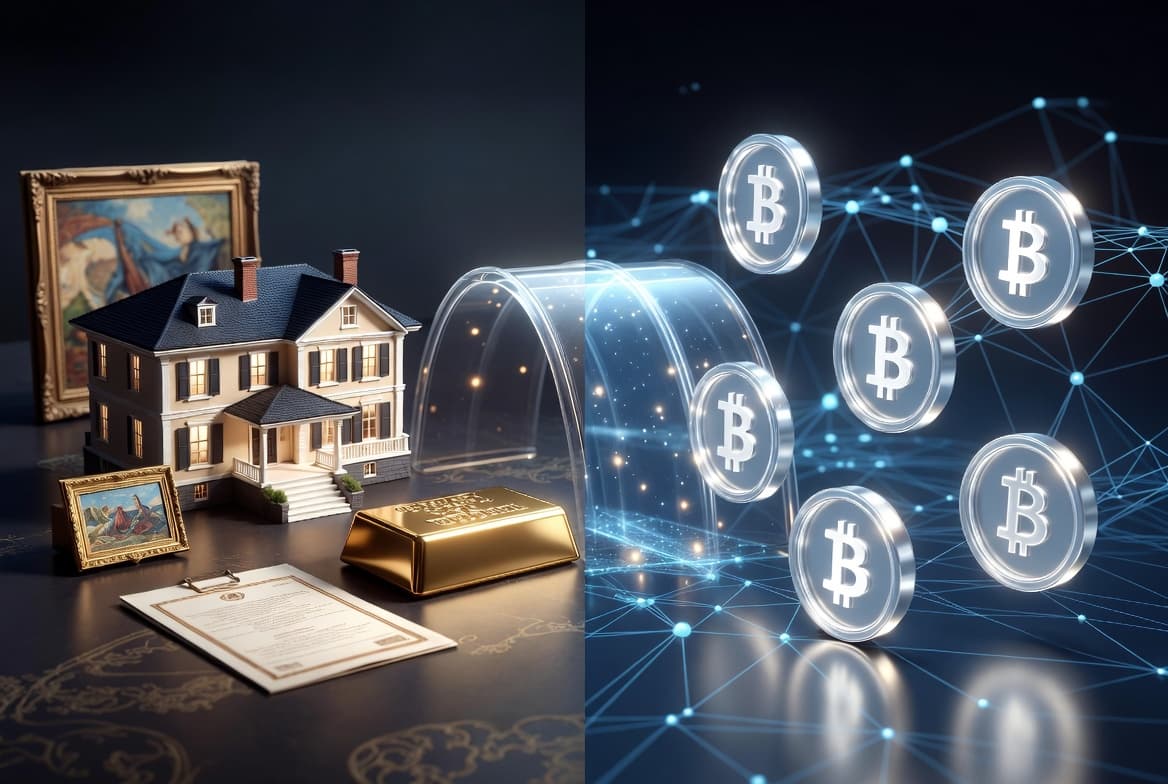
Real-world assets bring things like Treasury bills, real estate, and gold onto the blockchain. Here's what RWAs actually are, how tokenization works, and the risks to know.
For most of its history, crypto was good at one thing: creating assets that only existed on a blockchain. Bitcoin, Ether, governance tokens, none of them represent anything in the outside world. Real-world assets flip that idea around. They take something that already exists off-chain, like a government bond or a building, and put a digital version of it on a blockchain.
That's the whole concept in one sentence. But the details are where it gets interesting, and where the risks hide.
WHAT "RWA" ACTUALLY MEANS
A real-world asset token is an on-chain representation of a claim on something off-chain. The key word is claim. When you hold a tokenized Treasury, the blockchain doesn't somehow own the bond. The bond sits in the traditional financial system, held by a custodian, wrapped in a legal structure. The token is just a way to track and transfer your rights to it, fast and around the clock.
This is the part people get wrong. Tokenization doesn't magically change what an asset is. If something is treated as a security off-chain, it's still a security once it's tokenized. The blockchain is plumbing, not a loophole.
HOW TOKENIZATION WORKS
It usually goes like this. First, the asset gets a legal structure, often a fund or a special purpose vehicle that actually holds the underlying thing. Then a smart contract issues tokens that represent shares or claims on that structure. From there, the tokens can be bought, sold, or used as collateral on-chain.
There are always two layers working together. The on-chain layer is the tokens and smart contracts. The off-chain layer is the legal ownership, the custody, and the people managing the asset. If either side fails, the token is in trouble. A token is only as trustworthy as the legal and operational structure standing behind it.
WHAT'S BEING TOKENIZED
By mid-2026, more than $30 billion sits in tokenized real-world assets, not even counting stablecoins. The biggest category by far is short-term US government debt. Tokenized Treasury products alone have passed $12 billion, paying yields in the rough range of 4 to 5%.
Beyond Treasuries, the market spans money market funds, investment-grade corporate bonds, private credit, commodities like gold, real estate, and even equities. Private credit tends to offer higher yields, often quoted around 9 to 12%, but it also carries more risk. Each category behaves differently in terms of liquidity and what can go wrong.
WHO'S BUILDING THIS
This isn't a fringe corner of crypto anymore. BlackRock, the largest asset manager in the world, runs a tokenized Treasury fund worth billions that can now be used inside DeFi lending protocols. Franklin Templeton has its own on-chain money fund. On the crypto-native side, Ondo Finance focuses on tokenized fixed income, and MakerDAO has held over a billion dollars of real-world assets to back its DAI stablecoin. When names like these show up, it stops being a science experiment.
WHY PEOPLE CARE
Three things drive the interest. First, yield: RWAs let crypto holders earn returns backed by real-world income like Treasury interest, instead of relying only on crypto lending. Second, access: tokenization can split an expensive asset into small pieces, so you don't need a fortune to own a slice of something. Third, speed: on-chain assets can settle and move 24/7, without the delays and middlemen of traditional finance.
THE RISKS YOU SHOULDN'T SKIP
RWAs are not a free lunch, and they carry risks that pure crypto doesn't. Custody risk: someone off-chain holds the real asset, and you're trusting them. Counterparty risk: the issuer or fund could fail. Regulatory risk: rules are still forming and vary by country. Liquidity risk: a token can be hard to sell or redeem when you actually want out. And on top of all that, the usual smart contract risk that comes with anything on-chain.
The honest summary: tokenization makes an asset easier to move, but it doesn't remove the risk of the asset itself, and it adds a few new ones.
Real-world assets are one of the clearest examples of crypto and traditional finance actually merging, rather than just competing. The market is real, the players are serious, and the yields are tangible. But a tokenized asset is still only as solid as the legal structure, custodian, and issuer behind it. Treat the token as what it is, a claim, and do your homework on who's standing behind that claim.
This article is for informational purposes only and is not financial advice.